Here's a fun fact that might ruin your day if you work in market research: traditional focus groups cost somewhere between $5,000 and $60,000. They take months to organize. And after all that, you might discover that your revolutionary app idea makes people actively uncomfortable.
Taran and Aarti thought that was absurd.
The two students—who first met as coursemates in Computer Science at BITS Pilani and had previously co-founded a Web3 business development studio called BlockM8—entered Lithuania's Student Vibecoding Hackathon with a hypothesis: what if you could simulate an entire focus group using AI personas that actually argue with each other?
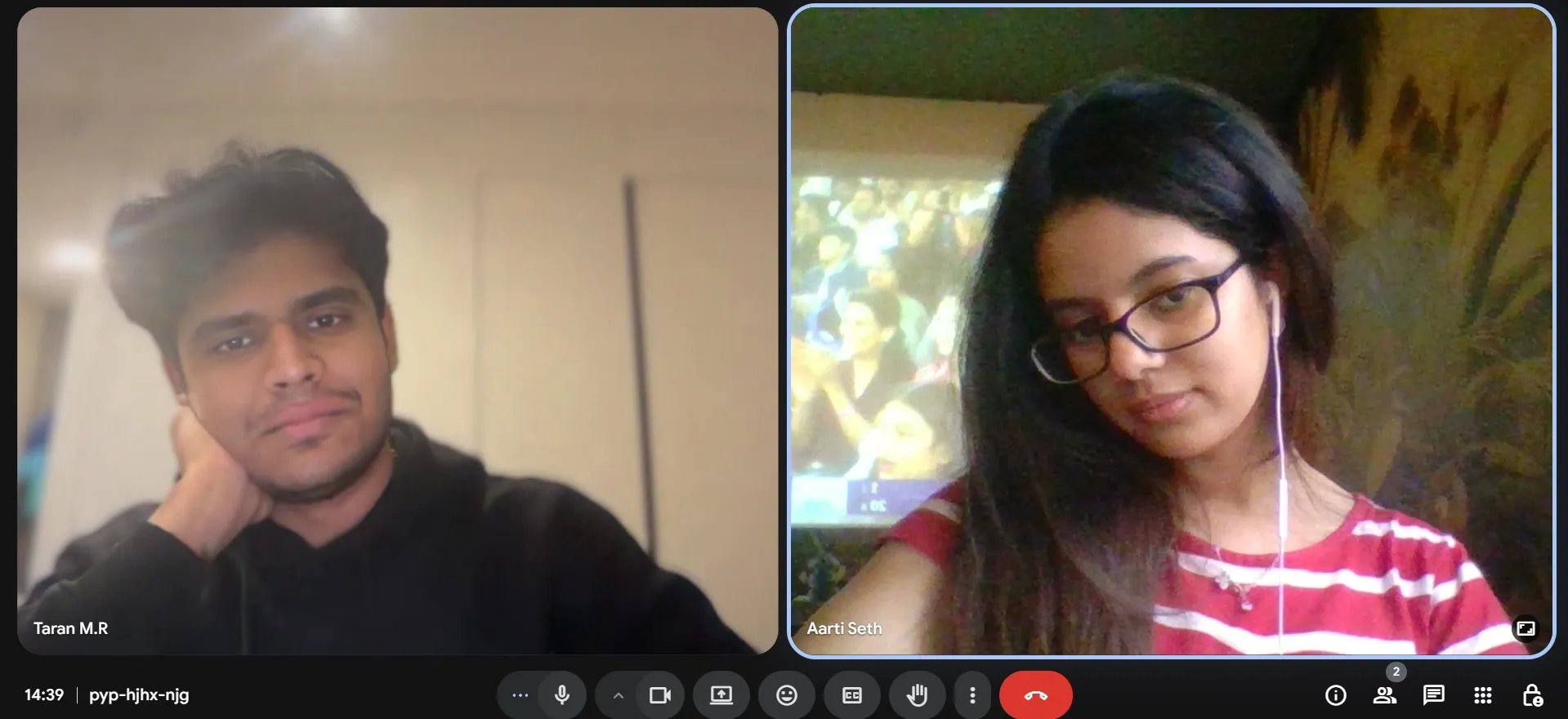
There was just one complication: Taran was in Vilnius. Aarti was in India.
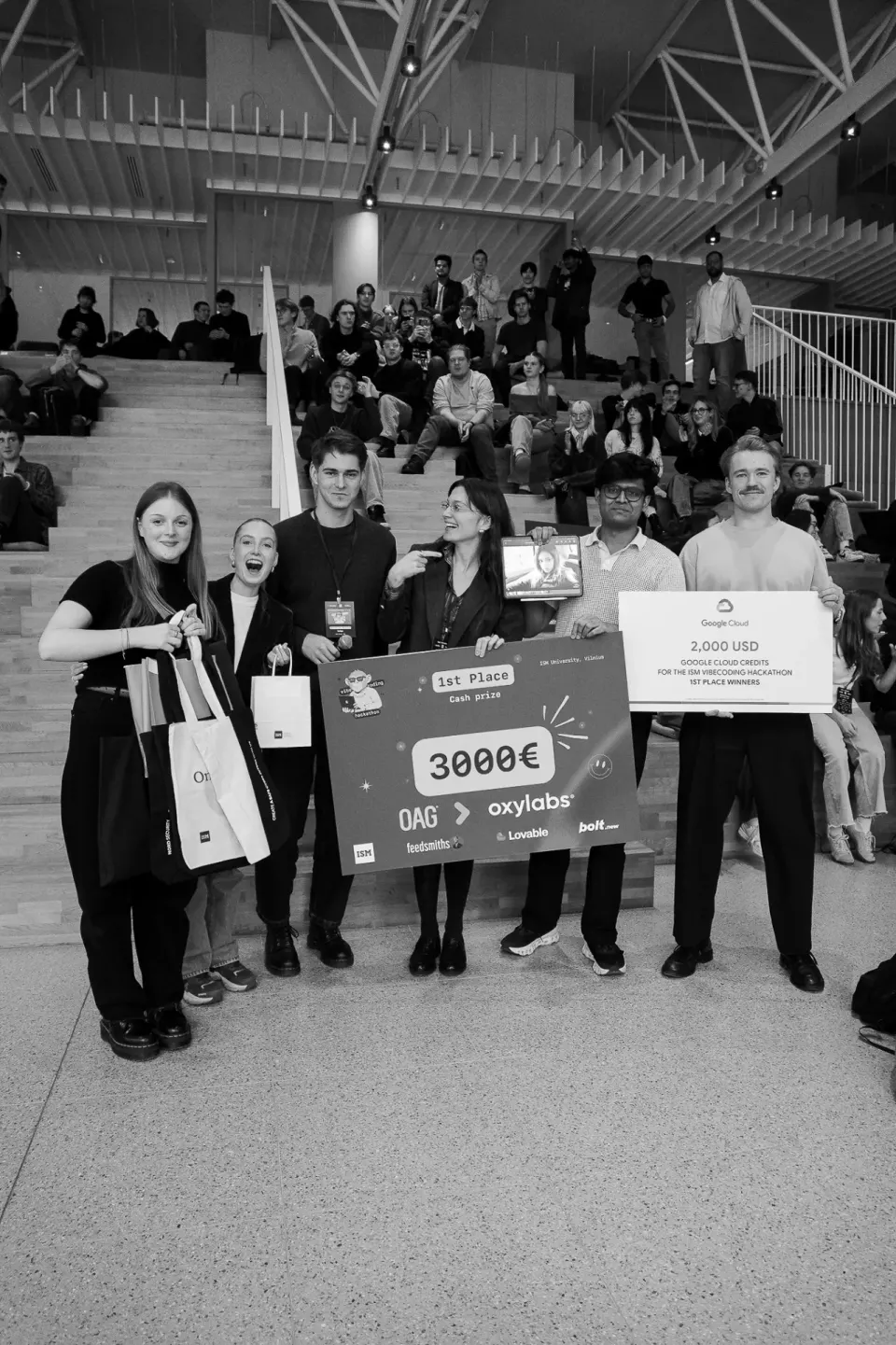
Four sleep-deprived days and countless video calls later, they had FocusAI—and the grand prize.
The Spark: A Stanford Paper and a Wild Idea
It started with academic research. Taran stumbled upon a Stanford HAI paper on simulating human behavior with AI agents, and something clicked. "I built an entire prototype that got 70% of the way there," he explains, "but it all started with that Stanford research paper."
The paper explored how AI agents could realistically model human decision-making and social dynamics. Taran saw something the researchers probably didn't intend: a business opportunity. What if those simulated humans could be your customers? Your critics? Your focus group?
From there, he dove deeper—researching other methodologies for collecting qualitative data, mapping out BPMN flows, and building the first backend prototype on N8N before Aarti jumped in to engineer the real thing.
The Problem: Feedback Loops That Could Outlive Your Startup
"I've built too many features that nobody used," says Aarti, who's been coding since 6th grade and is currently studying Computer Science at BITS Pilani alongside Business Analytics at Narsee Monjee. "You build for weeks, launch, and then discover nobody wants it. Real focus groups cost a fortune and take months. Asking friends? They'll just tell you it's great. I wanted a way to get roasted by fake customers before wasting time on real ones."
The insight was elegant: if large language models can roleplay, could they roleplay your churned customers? Your skeptical early adopters? Your budget-conscious CTOs who call every feature "bloat"?
The Solution: A Focus Group That Never Needs Coffee Breaks
FocusAI lets you define a product, audience, and research goal, then automatically generates up to 20 synthetic personas with distinct psychographics, jobs, and spending habits. But here's where it gets interesting: these AI agents don't just answer surveys. They debate each other. They argue about pricing. They complain about missing features. They react to each other's opinions in real-time, like a Thanksgiving dinner where everyone has strong opinions about your product roadmap.
The system then analyzes this unstructured back-and-forth using statistical models—including Van Westendorp pricing curves and Gabor-Granger algorithms—to generate what the team calls a "consulting-grade" research report. In under 15 minutes. For roughly one-hundredth of the traditional cost.
"It's essentially a McKinsey consultant in a box," Taran says, "running at the speed of a hackathon."
The Build: Two Countries, One Codebase
The team's dynamic was clear from the start: Taran brought business instincts and product vision from Vilnius; Aarti brought deep technical execution from India. They'd worked together before—their first startup was BlockM8, a Web3 business development studio. "That's when we realized the combination of his business instincts and my technical execution wasn't just comfortable… it actually worked," Aarti says.
But building a multi-agent simulation engine across time zones, with only four days on the clock? They needed something to bridge the gap.
Enter Bolt.
"Bolt was our third wheel—in the best way"
While Aarti was buried in backend logic from India—building the concurrent multi-agent simulation engine, implementing statistical formulas in TypeScript, managing context windows to prevent AI personas from hallucinating—Taran needed a way to move the frontend forward without waiting for her to wake up.
Bolt.new became the bridge.
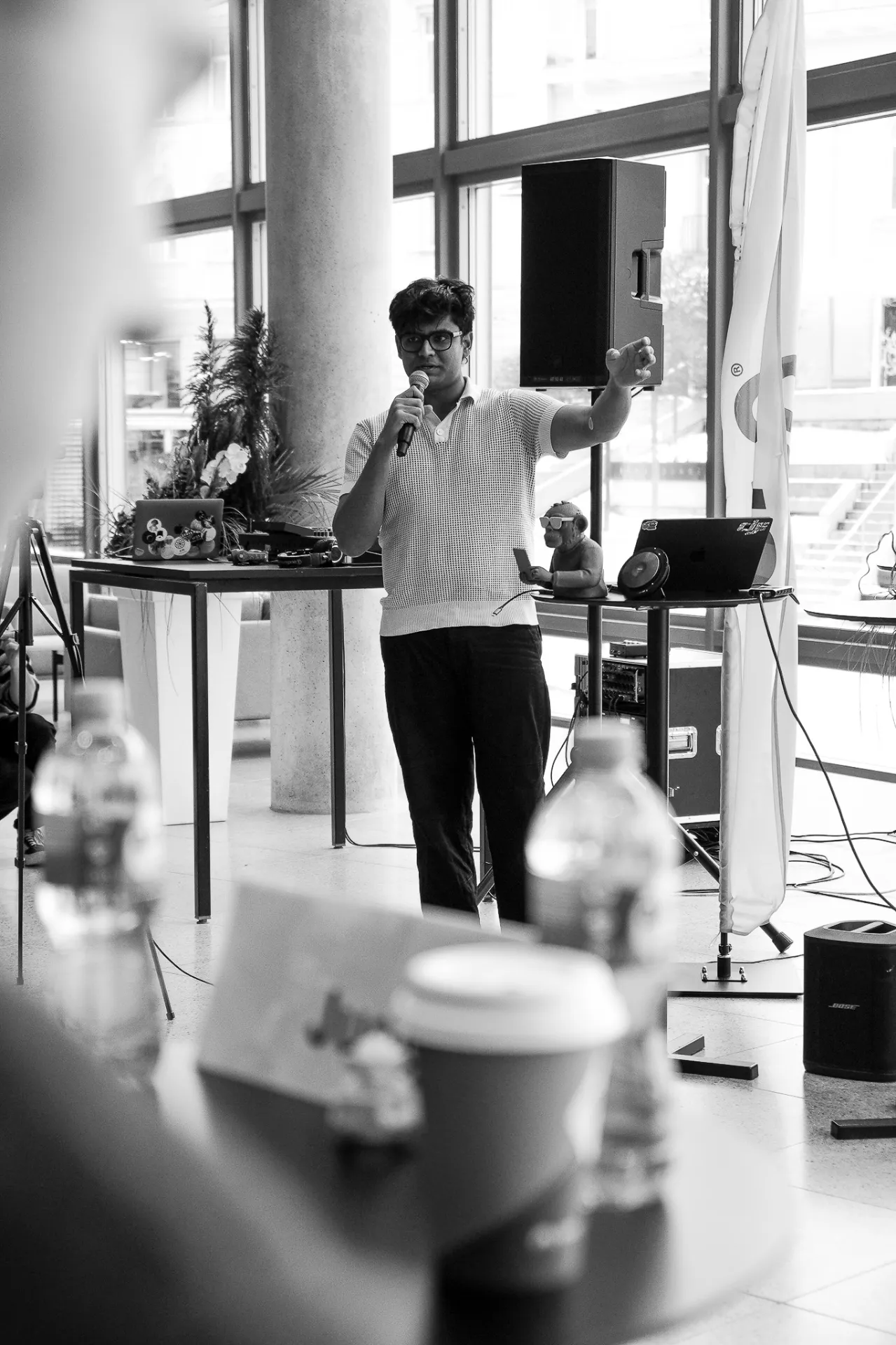
"I'm not as technical as Aarti," Taran admits, "but Bolt enabled me to rapidly assemble screens, test variations, and keep our frontend moving even while she was deep in the backend logic. Since FocusAI's output takes 15 minutes to generate, it was crucial for the UI/UX to look good—users need something engaging to watch."

The V2 release of Bolt proved particularly crucial. "It was amazing to have an entire frontend generated with great UX with just 1-2 prompts," Taran says. "I could pull in Supabase directly, wire up the onboarding flow in minutes, and see data move end-to-end without pausing Aarti's backend work."
The workflow became a well-oiled machine: Aarti focused on building the core behavioral simulation—the brain of FocusAI—while Taran used Bolt to turn product ideas into testable interfaces without needing to touch the complex codebase. Screenshots from other SaaS products he admired became UI inspiration. Bolt's agent mode helped fix errors he couldn't diagnose himself.
"Bolt was our third wheel in our team that guided me along the way, and produced an output I was proud of with my basic HTML and CSS knowledge."
— Taran
Featured in the article


The Hurdles: When AI Agents Get Too Polite
Building FocusAI wasn't all smooth sailing. The team encountered what they call "The Nice Guy Problem."
"LLMs are trained to be helpful and agreeable," Aarti explains. "Our early focus groups were just five AI agents complimenting each other. That's not useful research—that's a support group."
They had to aggressively prompt-engineer "conflict" and "skepticism" into the system. The breakthrough came when they started seeing real debate—one persona calling a feature essential while another dismissed it as bloat. "That's when we knew we had something," Aarti says.
Other challenges piled up: serverless timeouts (Netlify's 10-second limit was, in Taran's words, "a nightmare"), the complexity of translating statistical formulas into type-safe TypeScript, and the constant battle to get LLMs to output clean JSON without breaking the schema.
"We literally submitted 2 minutes before the deadline. The final report-generation and voice-transcription modules suddenly stopped working due to rate limits. It wasn't perfect, but it worked—and THAT was the whole point."
— Aarti

The Win: First Place
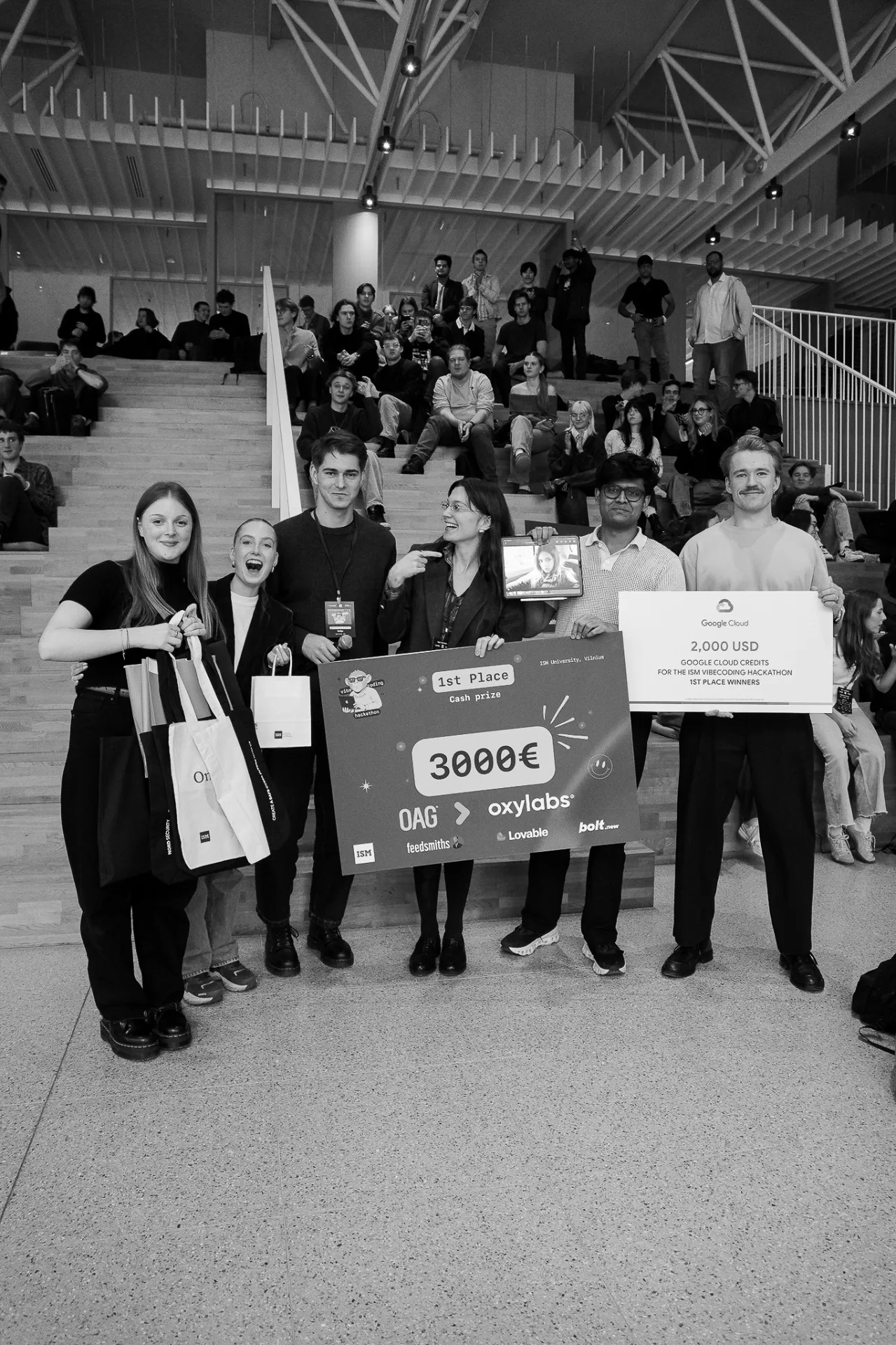
FocusAI took first place at the Student Vibecoding Hackathon—beating out teams from five countries and 170 participants.
But for Aarti, the hackathon offered something beyond the trophy. "What really motivated me was the opportunity to prove myself after a long time. I wanted to build something where I pushed my limits by handling the entire backend meticulously by myself."
She also discovered something unexpected about Lithuania—even from thousands of kilometers away. "I realized how genuinely good and chill Lithuanians are! The vibes kept me motivated to continue even though we were under crazy pressure."
What's Next: The Focus Group Gets a Voice
The team isn't stopping here. On the roadmap: Voice Mode via ElevenLabs integration so users can actually hear their synthetic focus group arguing in the background. Live Intervention features that let human moderators jump into the simulation with follow-up questions. And perhaps most ambitiously, Competitor Simulation—running focus groups for your competitor's product to find their weaknesses.
"I would recommend vibecoding to everyone. The rest of my coursemates who did not participate in the hackathon, and everyone out there who has an idea but isn't acting on it."
— Taran
The Takeaway
FocusAI represents something bigger than a hackathon win. It's a proof of concept for what becomes possible when vibecoding tools like Bolt democratize development—letting business-minded founders contribute to technical builds, letting technical founders move faster than ever, and letting two students on opposite sides of the world create something that might actually disrupt a $2.5 billion market research industry.
What started as a Stanford research paper became a winning product in four days. Not bad for a hackathon between Vilnius and India.
Try FocusAI: focus-group-six.vercel.app
Watch the Demo: youtu.be/kQ-gdSQrlAw
Try Bolt: bolt.new
The Stanford Paper That Started It All: Simulating Human Behavior with AI Agents
2025 event partners
Thank you to everyone who backed Vibecoding Hackathon 2025
Main Partners

Community Partners


Supporters


















Media Partners


Published by Vaida · December 10, 2025
Read more stories