Most New Year's resolutions do not fail loudly. They just evaporate. Someone says they will go to the gym. Someone else promises to learn a new skill. Everyone nods, everyone means it, and then real life quietly eats the promise for breakfast.
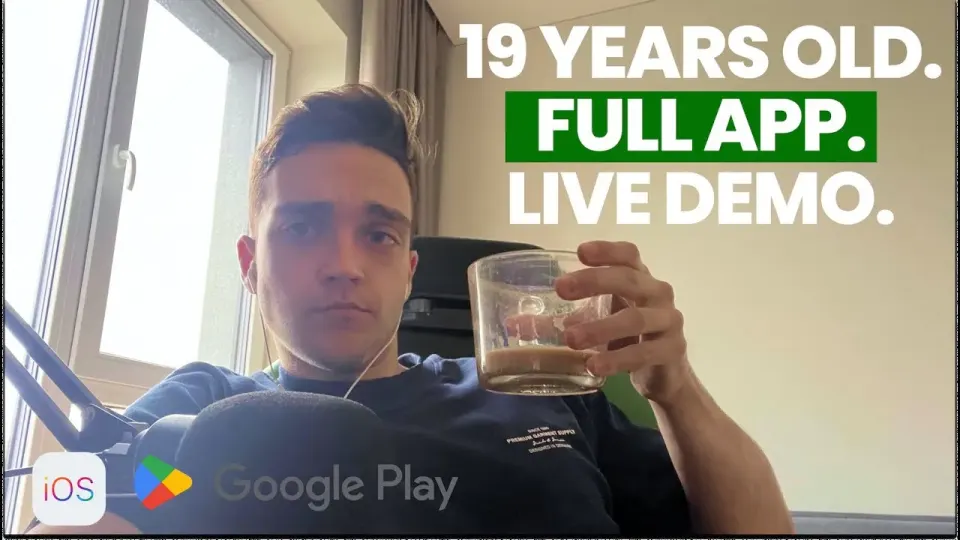
Karolis, a 19-year-old ISM University student from Lithuania, decided to make those promises harder to ignore. In about three days at a hackathon, using Natively, he built Habiton: a mobile app where friends send each other habit challenges, stake in-app currency, verify results with AI, and turn completed goals into shareable victory cards.
Here is the part that makes the story properly unfair: before the hackathon, Karolis barely coded.
From "printf hello" to a real mobile app
In Natively's 23-minute live demo and interview, Karolis explains that his coding background before the hackathon was basically introductory C++ level. The kind of level where you can print hello, feel briefly powerful, and then wonder what the rest of software engineering is hiding behind the curtain.
He joined the hackathon with three friends because it felt like a free chance to learn how AI creation tools actually work. No grand master plan. No years of engineering experience. Just a team deciding to go for it.
"It was an amazing opportunity for us to learn something new, to learn those AI creation tools."
— Karolis
By the end, he was talking about APIs, email flows, data sources, Supabase, Gemini, edge functions, authentication, and mobile deployment. The host called out the familiar hackathon switch that flips when something finally works: the moment where the team stops asking whether the idea is possible and starts asking how much further they can push it before the deadline.
That is the builder mindset in its purest form: one working feature becomes permission to try the next impossible thing.
The problem: promises with no witnesses
Habiton started from a very human annoyance: people make promises to themselves and to each other, especially around New Year, and then those promises disappear.
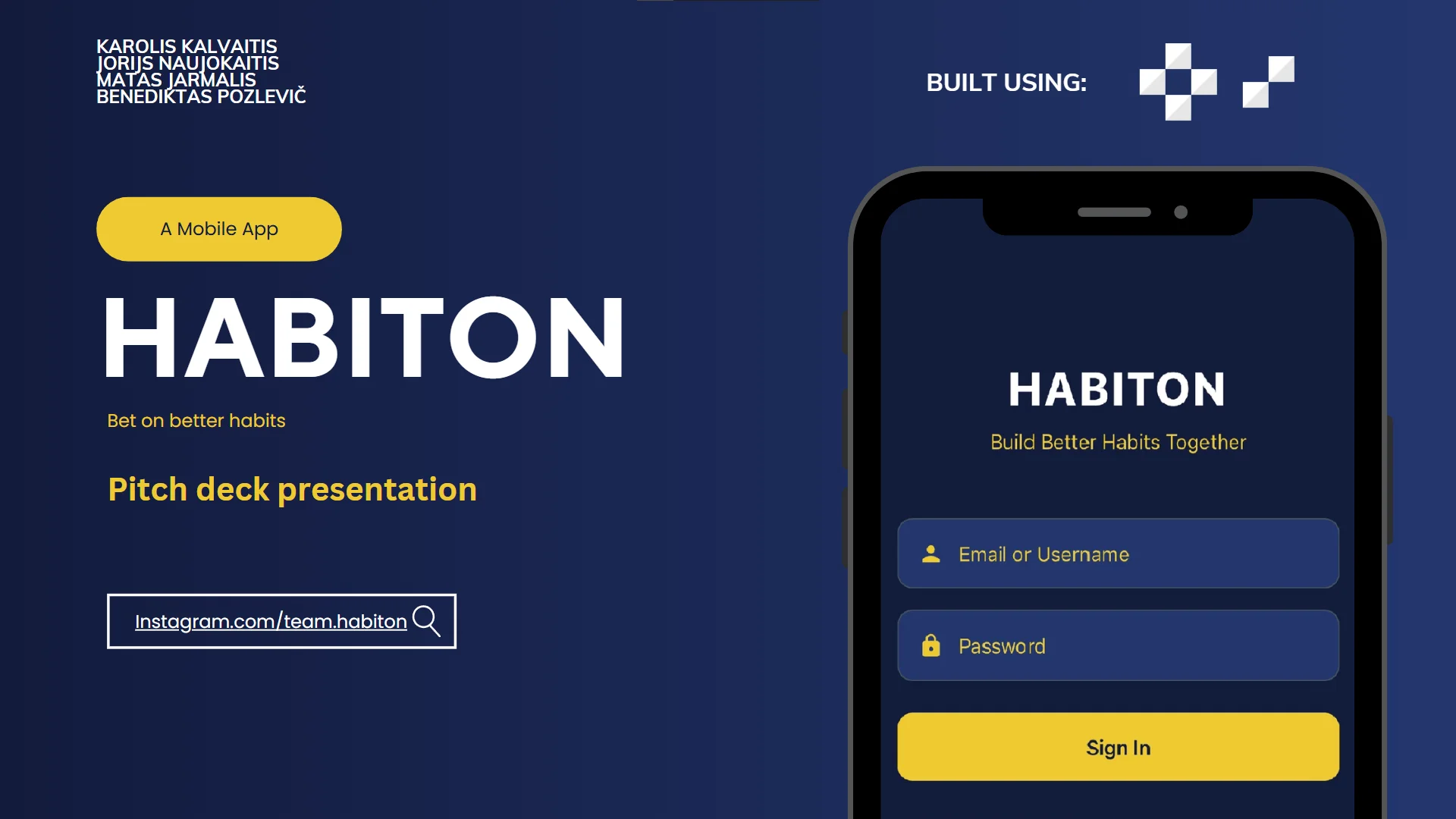
The team's Devpost submission put it in one line: Habiton is a "betting system of good habits" for friends and family. Their pitch deck sharpened it even more: Bet on better habits.
"All of those promises just basically fade out over the year. Everybody just forgets about them."
— Karolis
His example was painfully familiar. A friend keeps saying he will join him at the gym after a week, then after two weeks, then later. The promise stays friendly, vague, and consequence-free.
Habiton turns that soft promise into a challenge. You send someone a task, add a deadline, attach a stake, and let the app keep score. The point is not punishment. The point is to make the commitment visible enough that it starts behaving like a real thing.
- •Friends can challenge each other to concrete activities.
- •Each challenge can include a deadline and a reward split.
- •The app uses an internal currency called habs to create accountability.
- •Completed challenges can be verified, logged, and shared.
In the demo, Karolis walks through a stake example: if a challenge is set at €10 with a 50% reward, the winner gets €5, while losing costs the challenger more. It is a tiny economic nudge, but it changes the psychology. A habit is no longer just "I should probably do this someday." It is a small agreement with another person.
The app already feels surprisingly complete
The wild part of the interview is not that Habiton has one clever idea. It is how much product surface Karolis managed to ship around it.
Users can sign in with Google or create a new account. The team deliberately skipped email verification during the hackathon to reduce friction. After login, the app opens into a social profile page, closer in feeling to Instagram or Facebook than a bare prototype. You can upload a profile photo, zoom it, rotate it, flip it, and edit your name and username.
From there, the social layer kicks in. You search for friends, send invites, accept requests, view profiles, and see another user's challenge history and success rate. Challenges move through clear states: pending before the other person accepts, active once the challenge is live, and history once it is completed.
There is also a wallet. Habiton uses habs as its internal currency, including a developer promo code that adds 50 habs for testing. When a challenge resolves, the wallet records the movement: someone gains, someone loses, and the vague intention suddenly has a receipt.
The Gemini moment
The feature that makes Habiton feel especially current is AI photo verification. In the active stage of a challenge, the user uploads a photo as proof. Habiton sends that image to Gemini and asks whether the photo matches the challenge.
Karolis tests this live with a beautifully hackathon-ish attempt to cheat. The challenge is vague: take a picture. He uploads a random rock photo. Gemini approves it, because the challenge was broad enough that almost anything could count.
The lesson is perfect: AI verification works, but the quality of the proof depends on the quality of the challenge.
If the task is "take a picture," a rock passes. If the task is "take a photo of yourself at the gym next to the treadmill before 8am," the AI has something real to evaluate. Habiton accidentally teaches one of the most important lessons in building with AI: vague prompts create vague truth.
It even has negotiation and bragging rights
Habiton is not only accept-or-reject. If someone sends you a challenge and the terms feel unfair, you can haggle: send back a counter-offer with a different reward percentage. In the interview, Karolis counters for 50% of the bet because the challenge is harder than the original offer makes it sound.
There are achievements too, unlocking badges after milestones like completing 10 challenges. And for the show-offable moments, Habiton generates victory cards: designed summaries with your username, the challenge, the proof photo, the reward, and a short message. Karolis compares the sharing loop to Duolingo-style social bragging, which is exactly the right kind of harmless pressure for a habit app.
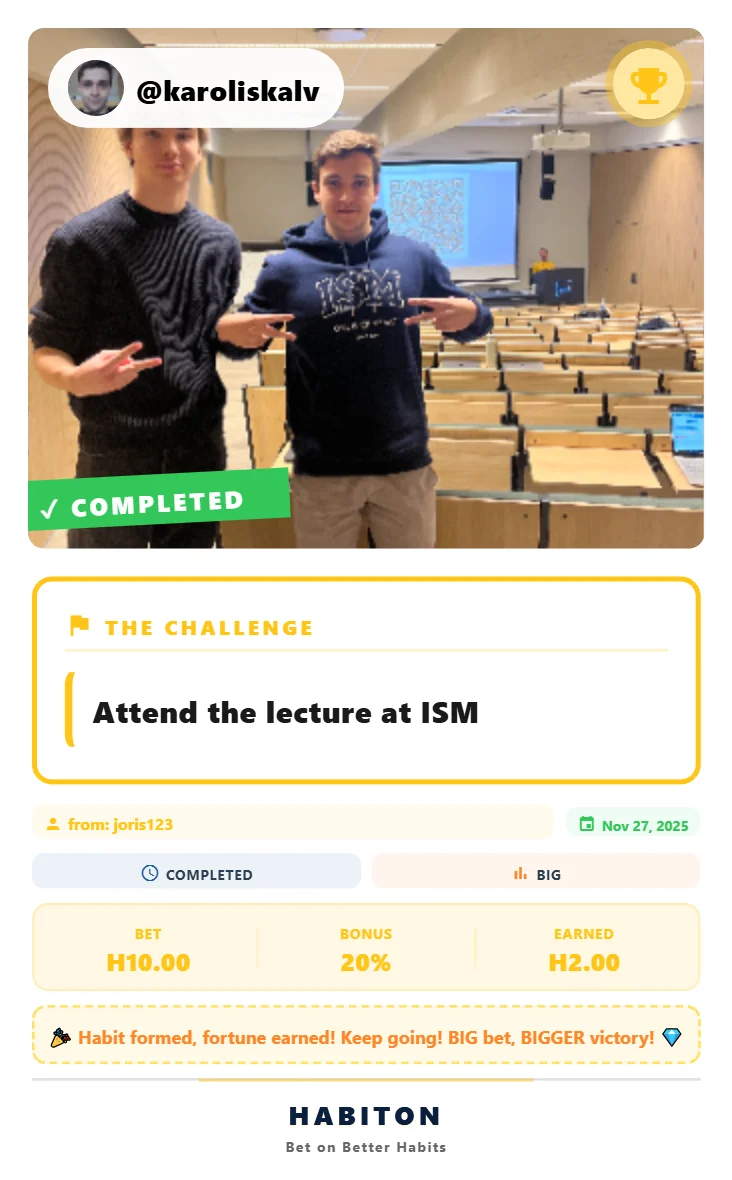
The example Victory Card from the submission makes the loop tangible: a challenge to attend a lecture at ISM, a completed status, a visible sender, a deadline, and a habs payout. It turns proof into something you can keep, download, or flex to friends.
The future roadmap has a store where people could spend habs on avatars or interface customizations. They did not finish it before the deadline, which is probably the most believable part of the whole story. Every hackathon app has one tab that points toward the next sprint.
Why this story matters
Habiton is not finished-finished. Karolis still wants to polish Instagram sharing, complete the store, and prepare the iOS and Android launch. But as a hackathon artifact, it is already far past the usual "nice landing page, theoretical product" zone.
It has accounts. It has social mechanics. It has money-like incentives. It has AI verification. It has a loop that starts with a promise and ends with proof.
"If I managed to do it with basically zero knowledge of how to code..."
— Karolis
That is the point of vibecoding. Not that tools magically remove thinking, taste, or persistence. They do not. Karolis still had to chase errors, test flows, make product decisions, and keep moving under hackathon pressure. But Natively gave him a way to translate intent into product faster than a beginner could have done before.
The team's own roadmap sentence might be the best ending: there are no obvious roadblocks. At this point, only imagination can stop them.
Learn more
See Karolis demo Habiton screen by screen, explain the Natively build process, and talk through what is left before launch.
Watch on YouTube2025 event partners
Thank you to everyone who backed Vibecoding Hackathon 2025
Main Partners


Community Partners


Supporters



















Media Partners



Published by Vaida · December 3, 2025
Read more stories